
AI-Powered Predictive Maintenance & Anomaly Detection
Enhancing Productivity & Minimizing Production Losses
Client
Challenge
Modern manufacturing landscapes face significant production losses, rising operational costs, and diminished workforce productivity due to unpredictable equipment failures. The client needed a scalable way to continuously perform real-time sensor data collection and monitor critical factory assets —specifically induction motors used across industrial settings and autonomous transfer vehicles deployed in smart manufacturing environments —without overloading centralized storage or missing high-low level operational anomalies.
Key Results
- Eliminated Primary Production Losses: Significantly mitigated downtime by predicting faults before they caused operational stoppages.
- Boosted Workforce Productivity: Empowered maintenance teams with targeted, early-stage fault classification alerts.
- Optimized Production Velocity: Increased overall production speed by ensuring asset availability.
- Resource Efficiency: Reduced data costs through intelligent cold data storage migration.
Solution
An end-to-end IoT and Machine Learning platform that ingests multi-sensory asset data, performs dual-stage (coarse and fine) real-time monitoring, and automatically runs fault prediction and anomaly classification models.
Steps Implemented:
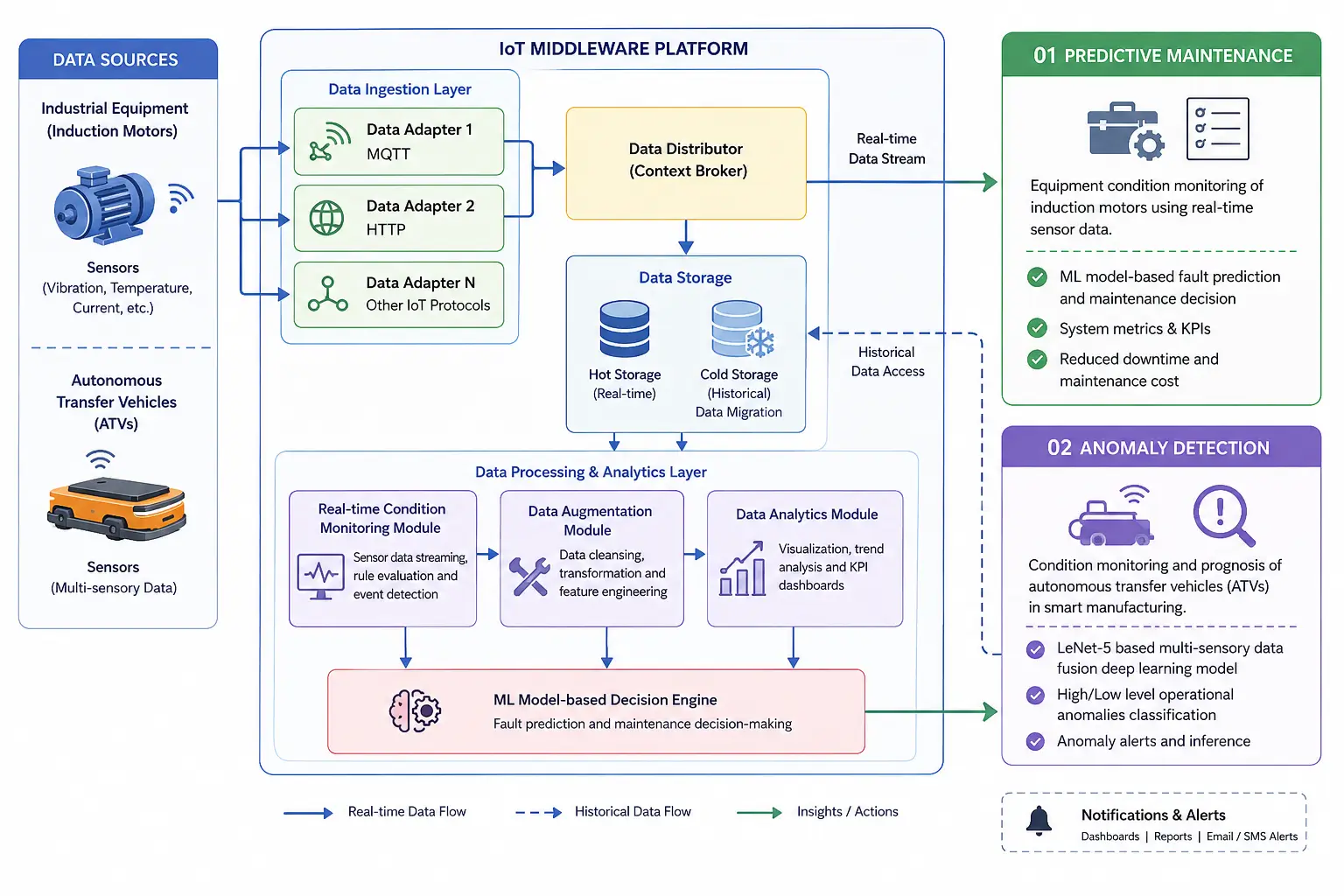
- Real-Time Data Ingestion: Implemented an IoT middleware layer supporting industry-standard protocols to collect continuous sensor streams from induction motors and autonomous vehicles.
- Dual-Stage System Monitoring: Configured a Real-time Coarse Monitoring Module for baseline checks, which automatically triggers a Fine Monitoring Module for advanced inference when anomalies are suspected.
- Deep Learning Inference: Deployed a LeNet-5 based multi-sensory data fusion deep learning model to accurately classify anomalies into high-low operational levels.
- Data Lifecycle Management: Route active data into a multi-DB hot storage system for rapid analytics, subsequently migrating older data to cold storage.
Key Components
- IoT Middleware & Data Adapters: Handles protocol-specific data ingestion from field edge devices.
- Data Distributor (Context Broker): Orchestrates incoming data packets to the correct storage and monitoring subsystems.
- Hot Data Storage Subsystem: Multi-database setup DB1,DB2,DBn optimized for low-latency, real-time data access.
- Real-time Coarse Monitoring Module: Provides continuous baseline tracking of asset health metrics (e.g., motor vibration data).
- Fine Monitoring Module: Deploys deep learning algorithms for deep fault classification and system metrics tracking.
- Data Augmentation & Data Analytics Modules: Enhances raw datasets and generates actionable system KPIs.
- Cold Data Storage Migration Gateway: Manages cloud-based historical archiving to minimize hot storage footprint.
Architecture Diagram
The architecture sequence below illustrates the technical data flow mapped out in the documentation:
Technologies Used
- MQTT & ROS (Data Adapters): IoT communication protocols utilized to establish highly efficient, real-time data collection from factory-floor machinery and autonomous vehicles.
- Context Broker (Data Distributor): Acts as the central middleware traffic manager to distribute context data across the platform seamlessly.
- Multi-DB Cluster (Hot Data Storage): High-speed, localized databases that securely retain immediate data for active processing and monitoring.
- LeNet-5 Deep Learning Model: A multi-sensory data fusion model trained to evaluate complex sensory inputs and classify faults into high-low operational anomalies.
- Cloud Storage Gateway: Facilitates long-term historical analysis and cost optimization through automated cold data migration.