
E-Commerce Application migration to AWS
A Leading U.S. E-commerce retailer specializing in swimming pool supplies
Client
A leading U.S. e-commerce retailer specializing in swimming pool supplies, equipment, and accessories. Running a high-traffic WordPress/WooCommerce storefront on a Nexcess-managed PaaS hosting environment, the company sought to migrate its entire application and 25 GB production database to AWS to gain greater control, scalability, and long-term cost efficiency.
Challenge
Client's existing hosting environment created growing constraints as traffic and catalog size expanded. Key gaps included:
- No AWS infrastructure — VPCs, subnets, or compute had not been provisioned
- Single-host deployment with no load balancing, failover, or Multi-AZ database redundancy
- No caching layer — uncached database queries under peak traffic causing latency spikes
- 25 GB MySQL database with no cloud-native migration path or minimal-downtime cutover strategy
- No centralized logging, monitoring, or alerting through AWS CloudWatch
- Static files served from the application tier — no CDN-integrated object storage
- SSL/TLS termination handled by host provider with no control over certificate lifecycle
Key Results
Measurable Impact Delivered
- 6 Weeks: End-to-end migration from kickoff to production cutover
- ~0: Downtime during production DNS cutover using DMS CDC replication.
- Multi-AZ: High-availability RDS MySQL with automated failover enabled
- Multiple EC2: Auto-distributed instances behind Application Load Balancer
- Redis Cache: ElastiCache for Redis deployed to offload database query pressure
Solution
Architecture & Migration Approach
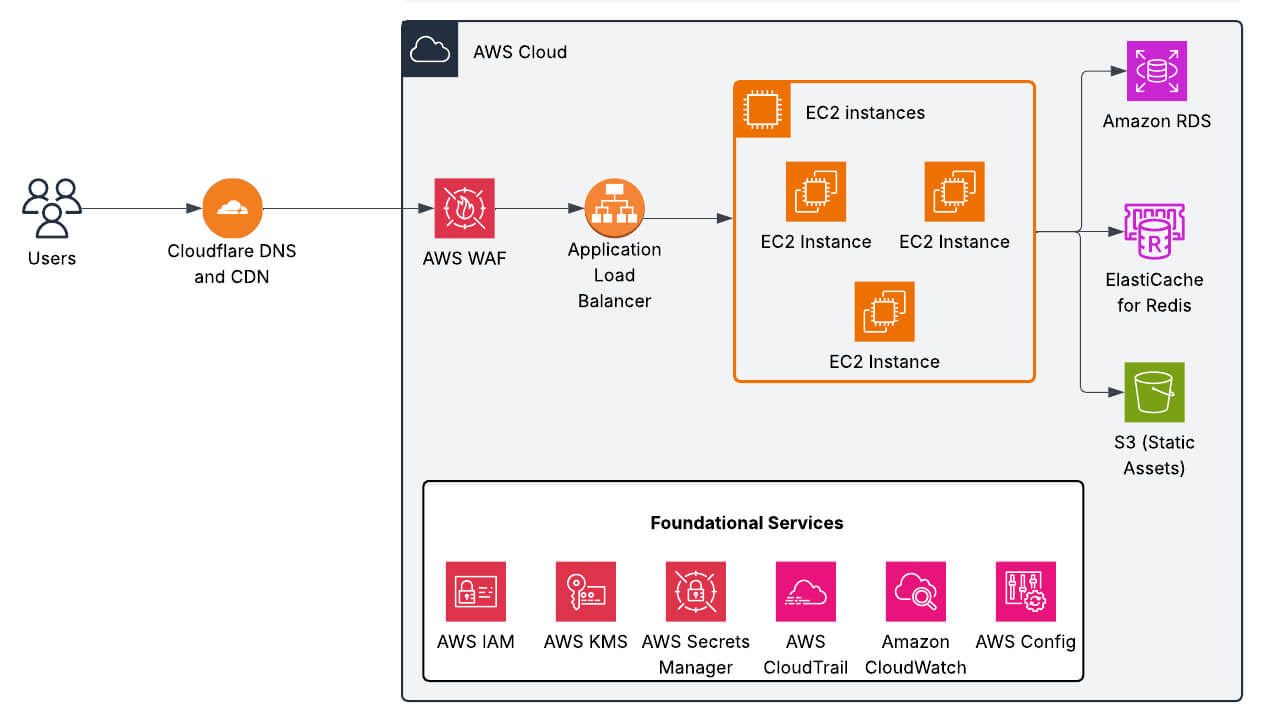
What we did
- Built the entire AWS environment from scratch — VPCs, public/private subnets across multiple Availability Zones, EC2 instances, security groups, and an Application Load Balancer with SSL/TLS termination for both staging and production
- Set up a high-availability database using Amazon RDS for MySQL with Multi-AZ failover, plus an ElastiCache Redis layer to speed up the site by caching repeated queries
- Migrated the 25 GB production MySQL database to AWS using DMS — first a full copy to staging for testing, then live continuous sync (CDC) so the production cutover could happen with virtually zero downtime
- Deployed the WordPress/WooCommerce application on EC2, reconnected it to the new database and Redis cache, and moved all media files to S3 backed by Cloudflare CDN for fast global delivery
- Ran full functional, performance, and load testing in staging using the client's own JMeter scripts, and worked through UAT sign-off with the Pool Warehouse team before going live
- Executed the production cutover by syncing the final database changes, flipping the Cloudflare DNS to point to AWS, and validating everything was working — then handed over architecture docs, runbooks, and a knowledge transfer session
Technologies Used
- Amazon EC2 (Compute — Web & App Tier)
- Amazon VPC — Multi-AZ Subnets & Routing
- Application Load Balancer (ALB)
- AWS WAF (Web Application Firewall)
- Amazon RDS for MySQL (Multi-AZ)
- Amazon ElastiCache for Redis
- Amazon S3 (Static Asset Storage)
- AWS Database Migration Service (DMS)
- AWS Systems Manager
- Amazon CloudWatch (Logging & Monitoring)
Summary
Client needed to escape the constraints of their Hosting PaaS and move their high-traffic WooCommerce store to a scalable, highly available AWS environment. In six weeks, we provisioned a full production-grade AWS infrastructure — multi-AZ VPCs, EC2 instances behind an ALB, Multi-AZ RDS MySQL, ElastiCache for Redis, and S3-backed static storage — migrated their 25 GB MySQL database with near-zero downtime using AWS DMS continuous replication, and executed a seamless Cloudflare DNS cutover. The result: a resilient, cloud-native e-commerce platform purpose-built for scale.
#arocom #artificialintelligence #machinelearning #datascience