
Automated Single-Cell Genomics & Brain Disorder Prediction
Accelerating Genomics with Hybrid AWS-GCP Infrastructure
Client
The client is a leading global research organization specializing in molecular neuroscience and therapeutic target identification. The institute focuses on analyzing large-scale transcriptomic datasets to uncover the precise genetic mechanisms underlying complex neurological and brain disorders.
Challenge
Traditional bulk genomic analysis tools average gene expression across tissue samples, masking critical population heterogeneity and leading to ambiguous cell fate decisions. To overcome this, researchers needed to perform single-cell transcriptomics to determine exact gene expression at the individual cell level. However, managing massive amounts of single-cell genomic data required an automated, scalable pipeline that could handle multi-step genotype imputation, data onboarding, cleaning, processing, and multi-axis visualization without single-cloud infrastructure limitations.
Key Results
- Accurate Disease Targeting: Leveraged AI to process massive datasets, successfully identifying disease-associated genes and predicting harmful mutations.
- Therapeutic Safety Forecasting: Deployed predictive models that forecast how effectively a gene-editing therapy will work and its likelihood of causing side effects.
- Elimination of Cellular Ambiguity: Successfully transitioned from bulk analysis to high-resolution single-cell analysis, enabling clear identification of specific cell subpopulations.
- Automated Data Processing: Created a fully automated pipeline for onboarding, cleaning, quality control, and genotype imputation.
- Optimized Cloud Strengths: Deployed a highly efficient multi-cloud infrastructure leveraging both AWS and GCP to optimize compute and storage capabilities.
- Instant Scientific Visualization: Enabled researchers to immediately generate complex violin chart plots of log counts of genes by cell type across specific brain regions (such as the Amygdala).
Solution
An automated, multi-cloud pipeline was developed to seamlessly ingest curated single-cell data, run secondary data quality control and imputation, and expose the structured results via interactive analytical dashboards.
Pipeline Execution Steps:
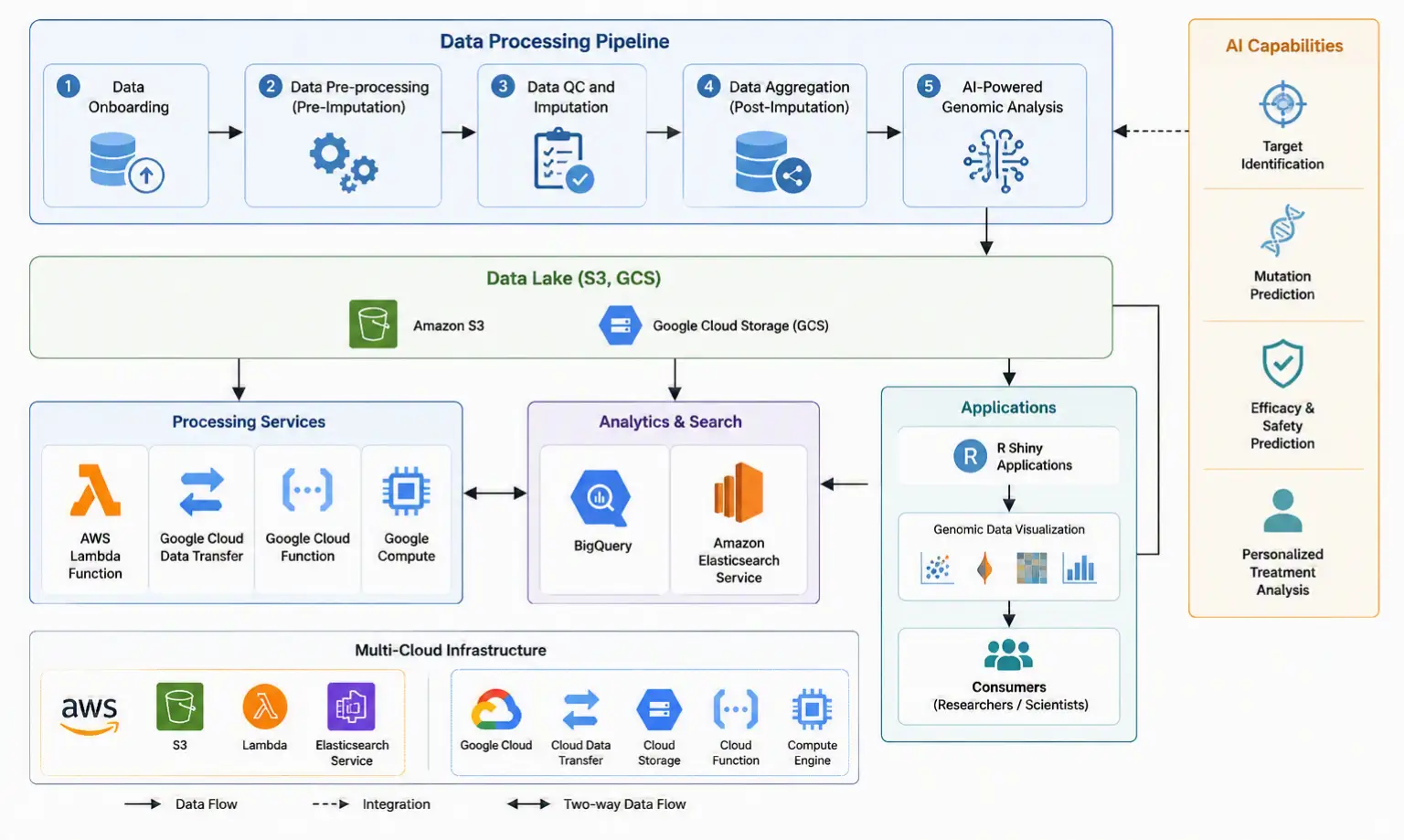
- Ingestion & Versioning: Data scientists copy the curated single-cell data (.Rdata or .Rda files) to a neuro-transient environment and check the corresponding dataset YML metadata file into GitHub.
- Multi-Cloud Splitting: An automated onboarding script executes to migrate the curated data files into the Google Cloud ecosystem, while an AWS Lambda function simultaneously stores the unstructured data file into an Amazon S3-backed data lake (neuro-datalake-ds).
- Automated Data Processing: A Google Cloud Function automatically triggers a Google Compute Engine instance to execute an R script, which cleans, processes, and onboards the data directly into Google BigQuery.
- Imputation Integration: Data undergoes strict pre-processing, QC, and genotype imputation utilizing the Imputation Server, followed by post-imputation aggregation.
- Consumption & Visualization: Finalized structured data is served to end-users through the BigQuery UI and interactive R Shiny web applications, allowing queries by Gene Name and Brain Region to yield instant violin chart visualizations.
Key Components
- Curated Single-Cell Data Ingestion Point (neuro-transient)
- Multi-Cloud Orchestration (AWS Lambda & Google Cloud Functions)
- Scalable Object Storage (Google Cloud Storage & neuro-datalake-ds)
- Automated Computation Engine (Google Compute Engine executing R Scripts)
- Enterprise Genomic Data Warehouse (Google BigQuery & Hail Analytics)
- Metadata Indexing Index (Amazon Elasticsearch Service)
- User Application Interface (R Shiny Applications Dashboard)
Architecture Diagram
The technical infrastructure layout below illustrates the automated end-to-end data pipeline from initial dataset curation to multi-cloud ingestion, processing, and consumer visualization dashboard delivery:
Technologies Used
- AWS Lambda: Used as a serverless function to direct and store unstructured data files into the Amazon cloud data lake (neuro-datalake-ds).
- Google Cloud Storage (GCS): Acts as the landing zone for the migrated curated genomic datasets before structure processing occurs.
- Google Cloud Functions: Serves as the event-driven trigger mechanism that automatically spins up or alerts the compute infrastructure when new data arrives.
- Google Compute Engine: Runs automated R scripts tasked with cleaning, processing, and structuring massive single-cell datasets.
- Google BigQuery: Operates as the central, high-performance repository for structured genomics data, supporting both open-source analysis and direct UI browsing.
- Amazon Elasticsearch Service: Utilized within the structured data tier to index and manage dataset metadata efficiently.
- BioData CATALYST / TOPMed Imputation Server: Provides the core pipeline components for genotype data pre-processing, QC, imputation, and aggregation.
- Hail: Employed alongside BigQuery to facilitate scalable, open-source genomics data analysis.
- R Shiny Apps: Serves as the interactive consumer application dashboard where researchers input gene parameters to visualize complex violin charts.
Summary
By deploying a hybrid AWS and GCP multi-cloud infrastructure, this project successfully automated the high-throughput pipeline required for single-cell transcriptomics. Moving away from traditional bulk tissue analysis enables researchers to completely eliminate ambiguous cell fate decisions and map exact gene expressions across distinct cell subpopulations. Ultimately, this cloud architecture provides an accelerated, automated path to studying cell-cell interactions and predicting crucial genetic contributions toward complex brain disorders.
#Biotech #Genomics #SingleCellAnalysis #CloudMigration #MultiCloud #AWS #DataScience