
Automated Cloud Desktop Provisioning for Semiconductor Workforce Development
A Semiconductor Workforce Development Organization
Client
A semiconductor workforce development organization focused on democratizing access to specialized EDA (Electronic Design Automation) software for engineers and students entering the industry. The client operates a grassroots community platform with partnerships across fabrication facilities and software vendors, serving as a critical talent pipeline for the US semiconductor supply chain as new fabs come online domestically.
Challenge
The client needed to provide individual, secure cloud desktop environments to each user — equipped with expensive, specialized semiconductor design tools — without incurring runaway compute costs or requiring heavy manual IT overhead.
- EC2 instances running 24/7 for every user were cost-prohibitive at scale, yet simply stopping instances would lose in-memory state, disrupting active engineering workflows.
- There was no automated process to provision new user environments; each new user required manual EC2 setup, DCV session configuration, and storage mounting — creating a bottleneck that could not scale with user growth.
- The existing setup lacked centralized authentication, making it difficult to enforce geo-location-based security controls (US-only access) and manage user identity consistently across the platform.
Without automation, the risk of orphaned instances, stale CloudWatch alarms, and inconsistent session states would increase operational debt and cloud spend significantly as the user base grew.
Key Results
- Reduced EC2 idle compute costs by an estimated 60–70% through automated hibernation triggered by CloudWatch composite alarms monitoring CPU, NetworkIn, and NetworkOut — preserving RAM state to disk so users resume exactly where they left off.
- Reduced new user onboarding time from hours to under 5 minutes by fully automating EC2 provisioning via a DynamoDB Streams-triggered Lambda pipeline integrated with the Cognito user registration flow.
- Eliminated manual IT intervention for session management, with automated wake-on-login, session recovery, and stale alarm cleanup across the entire user fleet.
Solution
Phase 1 – Lesion Detection (YOLO-Based GP Model)
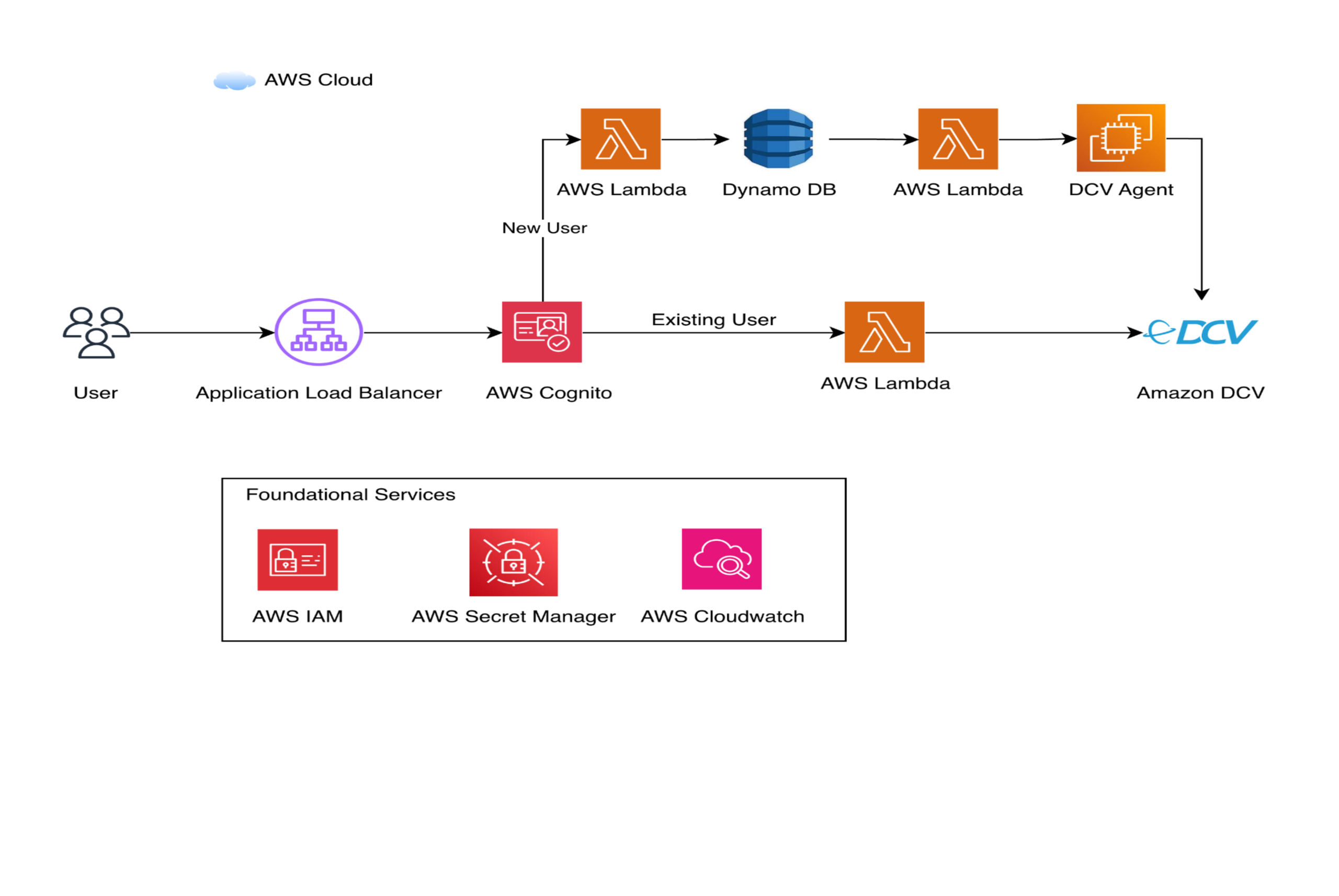
- Configured NICE DCV Access Console accessible via a custom URL, integrated with Amazon Cognito User Pools for centralized authentication and VPN based access
- Set up Route 53 DNS routing and an Application Load Balancer (ALB) with OIDC integration, enabling seamless browser-based redirect to the DCV session post-authentication.
- Built a fully automated provisioning pipeline using AWS Lambda functions covering the entire EC2 desktop lifecycle: user registration → instance provisioning → hibernation → wake-on-login → session recovery → termination → alarm cleanup.
- dynamodbWriter captures Cognito registration events and writes to DynamoDB, firing a DynamoDB Stream that triggers userInstanceProvisioner — the core engine that launches a hibernation-enabled EC2 instance, configures the NICE DCV agent via User Data, and mounts Amazon EFS for shared application storage.
- CloudWatch composite alarms (CPU + NetworkIn + NetworkOut) trigger hibernateEc2Instance to hibernate idle desktops, preserving RAM to disk. On next login, handleUserInstance wakes the instance via SSM, waits for the SSM agent, and re-creates the DCV session automatically.
- cloudwatchAlarmsCleanup runs periodically to eliminate orphaned alarms associated with terminated instances, preventing alarm sprawl and operational noise.
- A hardened AMI was created as the standard base image for all user EC2 instances, ensuring consistency and security across the fleet.
- CDK Infrastructure as Code (IaC) scripts were used for repeatable, version-controlled EC2 provisioning integrated with the new user onboarding workflow.
Technologies Used
- AWS Lambda
- NICE DCV & DCV Access Console
- Amazon EC2
- Amazon DynamoDB & DynamoDB Streams
- Amazon Cognito
- AWS CloudWatch Composite Alarms
- AWS Systems Manager (SSM)
- Amazon EFS
- AWS CDK (Infrastructure as Code)
- AWS Client VPN
#arocom #artificialintelligence #machinelearning #datascience