
AI-Powered Quality Control & Defect Detection
Convolutional Neural Networks (CNN) Based Visual Quality Inspection
Client
Client is a leading international manufacturer of high-precision metal casting components. They produce thousands of critical parts daily for automotive and industrial machinery applications, where even microscopic surface defects can compromise structural integrity.
Challenge
The quality inspection of casting products is the most critical step in determining whether a product is acceptable or must be rejected and scrapped/reworked. Manual inspections are often slow, subjective, and prone to fatigue-induced errors, which leads to primary causes of production losses and high operational costs. The client required an automated, reliable, data-driven approach to optimize production speed and ensure flawless quality control.
Key Results
- High-Accuracy Learning Curves: Attrived high training and validation accuracy within 12 epochs, as demonstrated by the convergence of the model's performance metrics.
- Minimized Production Losses: Successfully eliminated the primary causes of production losses and associated manual inspection costs.
- Resource Optimization: Optimized computational resources and training performance through automated pipeline tuning.
- Enhanced Speed & Productivity: Significantly increased workforce productivity and overall line production speed.
Solution
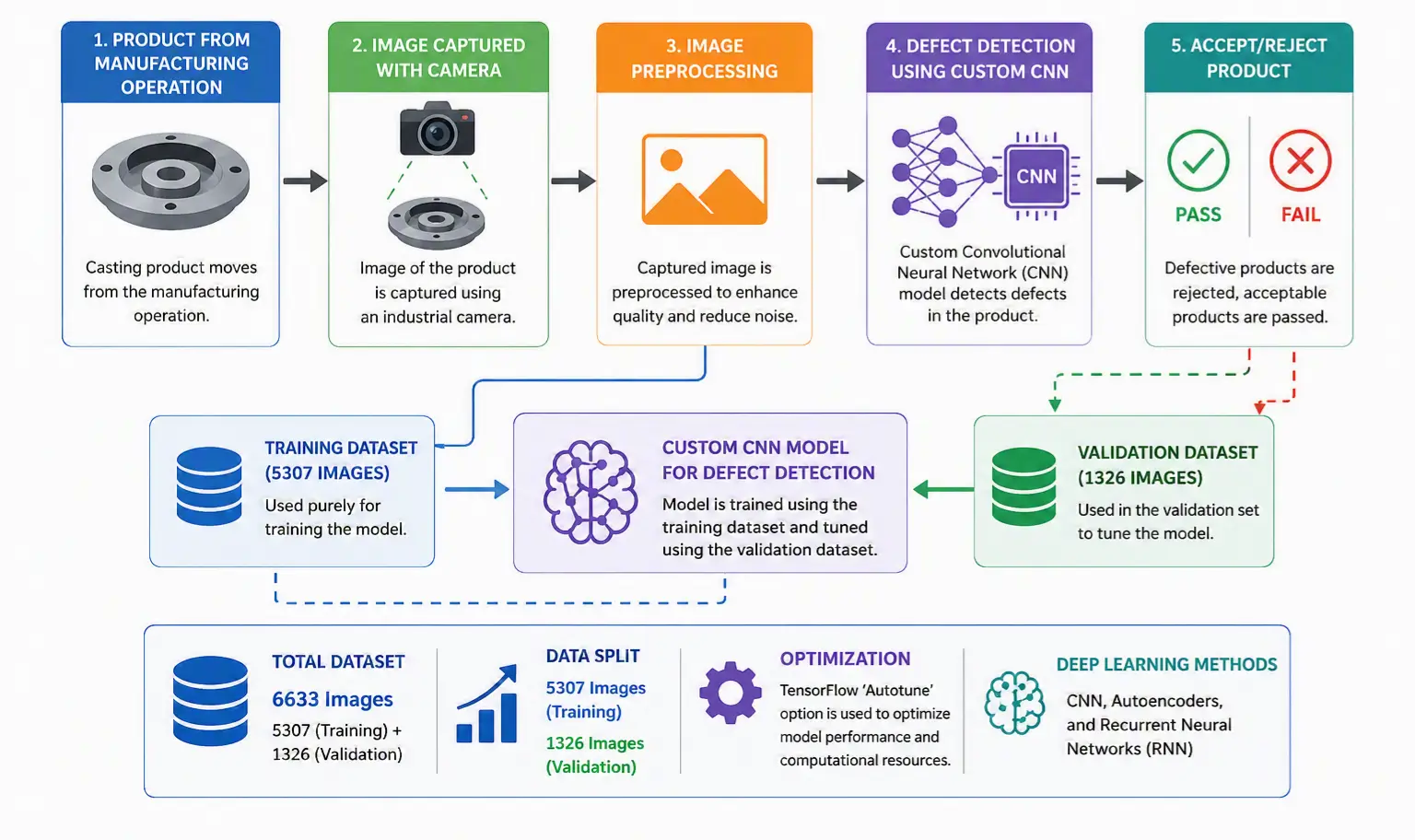
This solution automates visual defect detection by capturing product images directly from the assembly line and processing them through a deep learning model to instantly classify pass/fail status.
- Step 1: Retrieve the finished product directly from the manufacturing operation conveyor.
- Step 2: Capture a high-resolution top-down visual image of the casting product using an industrial camera.
- Step 3: Perform image preprocessing to clean, normalize, and format the image for model readiness.
- Step 4: Run defect detection and feature evaluation using a custom Convolutional Neural Network (CNN).
- Step 5: Automatically decide to accept or reject the product based on model outputs (Pass/Fail).
- Step 6: Record and store inspection results in the localized digital Inspection Log for compliance and auditing.
Key Components
- Manufacturing Operation Line Output: The physical entry point of the casting products.
- Camera Image Capture Module: Hardware interface to acquire product snapshots.
- Image Preprocessing Unit: Computational step to prepare data for the neural network.
- Custom CNN Classifier: The core deep learning engine configured for defect detection.
- Accept/Reject Routing Mechanism: Logic unit sorting products into PASS or FAIL workflows.
- Inspection Log Storage: Automated logging ledger for quality assurance tracking.
Architecture Diagram
Technologies Used
- Custom Convolutional Neural Networks (CNN): Used as the primary deep learning method to yield excellent results in complex visual inspection applications.
- TensorFlow ('Autotune'): Utilized to optimize the runtime performance of the model and manage the usage of computational resources efficiently.
- Deep Learning Frameworks (CNN, Autoencoders, RNN):Methodologies used increasingly to provide excellent results on a variety of product quality inspection applications.
Summary
By replacing manual observation with a data-driven deep learning inspection system, this solution transforms the quality assurance landscape for manufacturing lines. Utilizing a custom CNN trained on a robust dataset of 6,633 images, the system provides instantaneous pass/fail classifications, resulting in optimized computational efficiency, faster throughput, and a dramatic reduction in operational waste.
#ManufacturingAI #QualityControl #ComputerVision #SmartManufacturing #DefectDetection