
AI-Powered Drug Discovery and Development
Enhancing target discovery and drug design through data integration
Client
A confidential healthcare and life sciences research enterprise specializing in neuro-behavioral phenotypes and advanced molecular therapeutics.
Challenge
The traditional lifecycle of drug discovery and development requires navigating complex processes to connect disorders or symptoms to effective treatments. Specifically, researchers need a systematic way to process large datasets of biological data to identify drug targets, predict drug efficacy, design new drugs with fewer side effects, optimize clinical trials, predict potential adverse events, and verify drug formulation stability. Without automation, manually aligning neuro-behavioral phenotypes, multi-modal imaging, genetic maps, and chemical structures for molecular docking remains highly fragmented.
Key Results
- Identified promising drug targets by analyzing large biological datasets.
- Predicted drug efficacy and target binding behaviors through systematic data analysis.
- Generated novel drug candidates with specific properties using advanced Generative AI models.
- Designed more efficient clinical trials by predicting optimal dosage, treatment duration, and patient subgroups.
- Predicted potential adverse events and risks proactively by analyzing historical clinical trial data.
- Repurposed existing drugs (e.g., thalidomide for multiple myeloma) and predicted formulation stability under varying storage conditions.
Solution
An integrated, compliant data pipeline that maps neuro-behavioral phenotypes and genetic data to drug targets, enabling automated molecular docking simulations and scoring.
- Map the disorder or symptom to specific neuro-behavioral phenotypes and drug targets (such as specific receptor subunits).
- Aggregate input datasets, including multi-modal imaging data (tb-fMRI, rs-fMRI, DWI, structural, MEG, PET), genes, and microarray data from AHBA (6 subjects).
- Calculate the element-wise product of genes and phenotype maps to build gene expression maps and weight maps.
- Ingest molecular configurations using Molecular SMILE (Simplified Molecular Input Line Entry) structures and execution parameters (Config, Mol2 prepSDF).
- Execute docking simulations inside the docking software with optional configurations like masking, priority, and penalty.
- Generate output SDF files and score the phenotype-drug target pairs via correlation and overlap analysis into CSV scoring files.
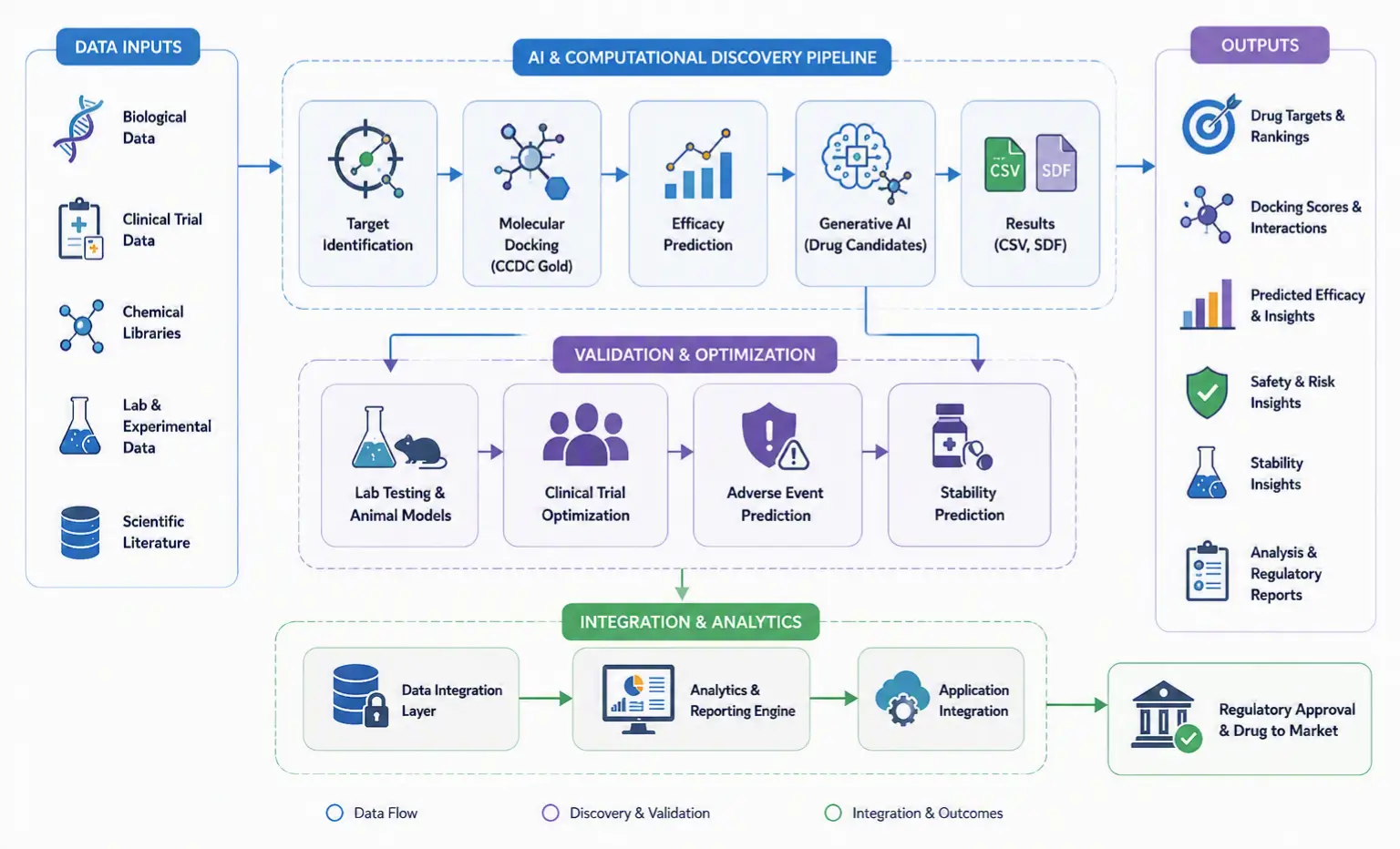
- Pass through the sequential lifecycle phases: identify target, simulate interactions, test in lab/animals, conduct human clinical trials, perform analysis/reporting, and secure regulatory approval.
Key Components
- Data Input & Ingestion Layer: Accepts Molecular SMILE entries, Microarray data from AHBA (6 subjects), Execution Parameters (Config, Mol2 prepSDF), and optional settings (masking, priority, penalty).
- Modality Processing Hub: Ingestes and processes tb-fMRI, rs-fMRI, DWI, structural, MEG, and PET data.
- Mapping and Product Core: Executes the element-wise product of genes and phenotype maps to deliver Gene Expression Maps and Weight Maps.
- CCDC Gold Docking Software Execution Interface: The centralized framework that executes molecular docking using input SDF files.
- Output Processing and Scoring Engine: Translates simulation data into SDF files, CSV scores, and final Phenotype-Drug Target Pair Scores/Rankings.
- Pathfinder Apps Integration Module: A secure and compliant gateway allowing read/write operations and integration of proprietary or third-party data.
Architecture Diagram
Technologies Used
- CCDC Gold Docking Software: Used to execute the core molecular docking simulations based on the prepared input configurations.
- Molecular SMILE (Simplified Molecular Input Line Entry): Deployed as the standard format for representing and ingesting molecular chemical structures into the system.
- Microarray Data (AHBA): Utilized from 6 subjects to construct spatial gene expression maps.
- Imaging Modalities (tb-fMRI, rs-fMRI, DWI, structural, MEG, PET): Utilized to systematically map out structural and functional neuro-behavioral phenotypes.
- Pathfinder Apps Integration: Provides a secure and compliant environment to support read/write capabilities and connect proprietary or third-party applications.
Summary
The platform developed by Arocom IT Solutions (P) Ltd addresses the key operational and scientific phases of drug discovery. By organizing raw input modalities, structural brain maps, and genomic data from AHBA, the platform computes element-wise matrix values to directly correlate symptoms to target receptor subunits like OPRK1. It passes these refined targets alongside Molecular SMILE data into the CCDC Gold Docking Software under tightly controlled execution parameters. The resulting data outputs automated CSV rankings and scores, creating a secure, compliant pathfinder architecture that lowers risks and improves safety throughout the development pipeline.
#arocom #artificialintelligence #drugdiscovery #bioinformatics #clinicaltrials #generativeai