
AI-Powered Dermatological Analysis
A Dermatology Technology Company
Client
A forward-thinking dermatology technology company leveraging artificial intelligence to enhance lesion detection and classification for dermatological diagnosis and research.
Challenge
Manual dermatological image analysis is time-consuming, subjective, and difficult to scale Detecting and classifying skin lesions across thousands of high-resolution images requires automation, consistency, and cloud-based scalability.
The objective was to develop an AI-powered Proof of Concept (PoC) capable of performing lesion detection and classification using deep learning models deployed on AWS infrastructure.
Key Challenges
- Building a two-phase AI model pipelinefor detection and classification.
- Creating a manual annotation workflowusing AWS Ground Truth.
- Managing large image datasetsefficiently on AWS S3.
- Establishing reliable and scalabletraining and inference on SageMaker.
- Automating data flow, model management, and deployment
Key Results
- Reduced analysis time from minutes to seconds– Automated lesion detection and classification decreased processing time per image from 5-10 minutes to under 10 seconds, enabling same-day preliminary screening results for patients and reducing wait times for specialist consultations.
- Achieved high-accuracy lesion identificationwith the YOLO-based detection model, successfully localizing skin lesions across diverse image conditions, multiple skin types, and varying lighting scenarios.
- Delivered consistent, objective lesion classificationinto 3 severity categories, eliminating the 15-20% subjective variability inherent in manual dermatological analysis and supporting more reliable clinical decision-making.
- Enabled scalable image analysis capabilities– Infrastructure designed to process thousands of high-resolution dermatological images daily, making large-scale research studies and population screening programs practically feasible.
- Created high-quality training datasetthrough manual annotation of 1,500+ dermatological images using AWS SageMaker Ground Truth, ensuring consistent labeling standards for robust model performance.
- Established modular two-phase pipeline architecturethat reduced model retraining cycles by 50%, allowing independent refinement of detection and classification components as new clinical data becomes available.
Solution
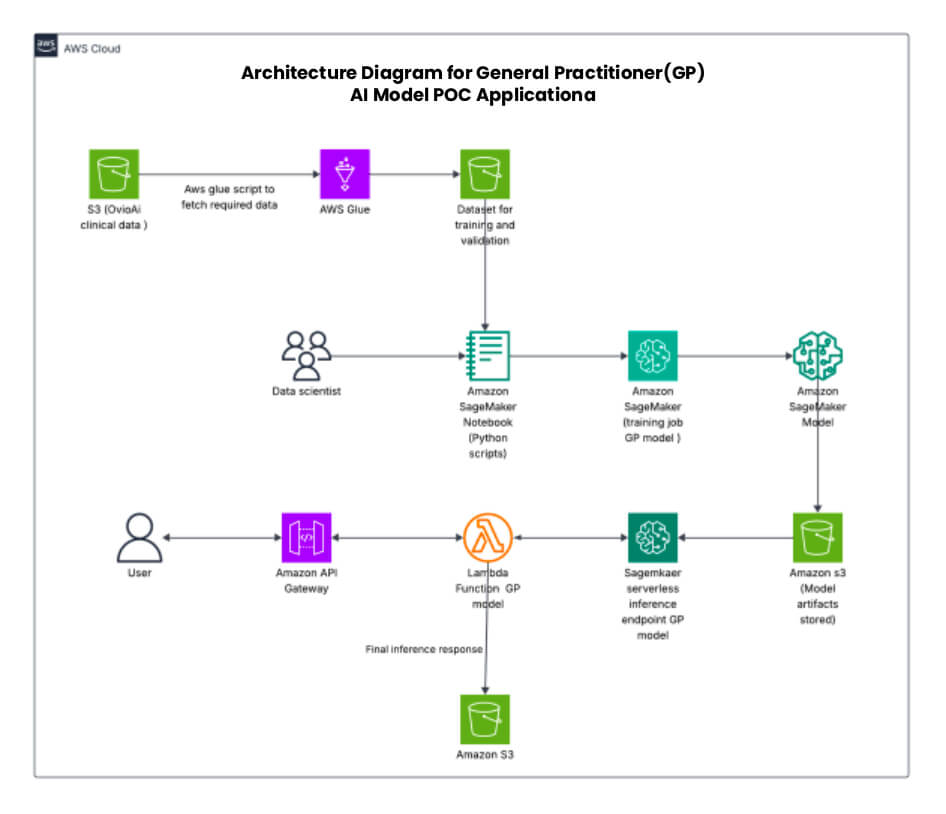
Phase 1 – Lesion Detection (YOLO-Based GP Model)
Key Components
- Data Layer:Dermatological images stored in Amazon S3 were manually annotated in SageMaker Ground Truth and converted into YOLO format for training.
- Model Layer:YOLO model trained on AWS SageMaker GPU instances; weights converted from .pt to ONNX for optimized inference.
- Processing Layer:Lambda and ONNX Runtime handled inference to detect lesions and generate bounding boxes with confidence scores.
- Automation Layer:Python + Boto3 scripts automated data handling, training, and inference.
Learning
- Manual annotation improved dataset precision and detection quality.
- YOLO provided fast, accurate detection with minimal post-processing.
- ONNX conversion made deployment lightweight and cross-compatible.
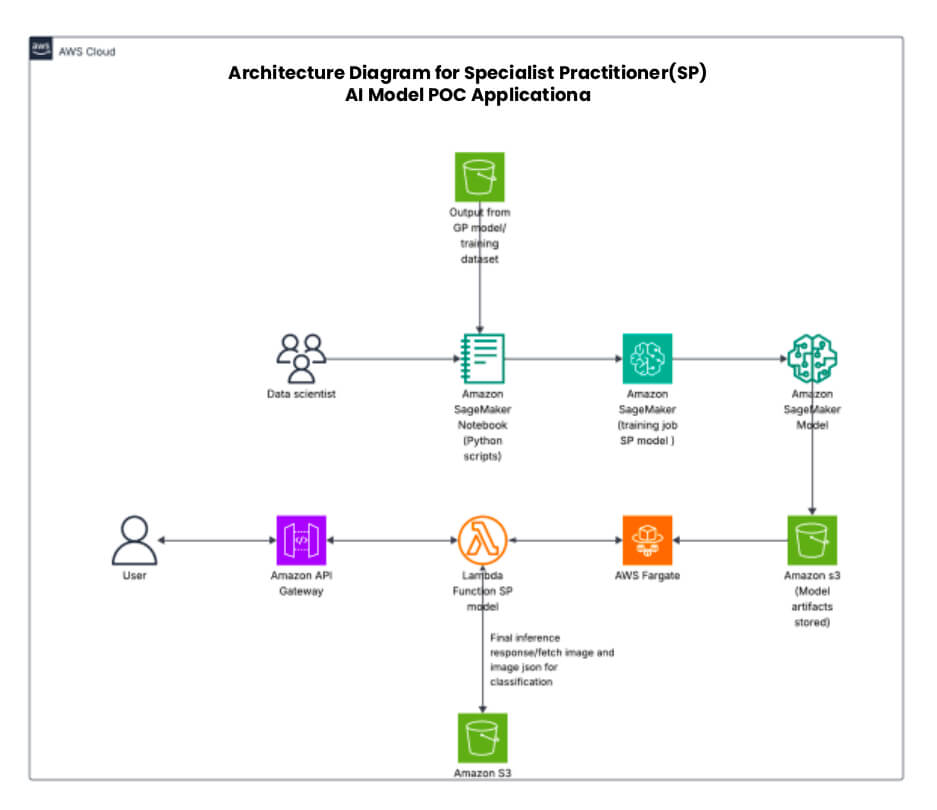
Phase 2 – Lesion Classification (VGG16-Based Specialist Model)
Key Components
- Data Layer:Cropped lesion images from YOLO detections were labeled into three categories and stored in S3.
- Model Layer: VGG16 fine-tuned on SageMaker using transfer learning with augmentation and class balancing.
- Processing Layer: Lambda and API Gateway integrated YOLO and VGG16 pipelines for real-time classification.
Learning
- Fine-tuning VGG16 improved classification accuracy across lesion types.
- Integration of YOLO and VGG16 enabled a smooth end-to-end automated workflow.
- Modular design allows independent model updates and scalability.
Our team designed and implemented a two-stage AI-driven dermatological pipeline using YOLO for lesion detection and VGG16 for lesion classification — both deployed and orchestrated using AWS SageMaker, S3, and Lambda.
Technologies Used
- AWS SageMaker– Used for training, validation, and deployment of the YOLO and VGG16 models with GPU instance management.
- Amazon S3– Serves as the centralized storage for datasets, model artifacts, and inference outputs.
- AWS Lambda– Executes the end-to-end inference pipeline, integrating detection and classification models.
- API Gateway– Provides secure endpoints to trigger and manage real-time inference requests.
- YOLO (PyTorch → ONNX)– Detection model (GP) for identifying lesions and generating bounding box coordinates.
- VGG16 (TensorFlow / Keras)– Classification model (SP) for categorizing lesions into severity levels.
- SageMaker Ground Truth (Manual)– Enables manual annotation of dermatological images for high-quality training data.
Summary
We delivered an AI-powered dermatological analysis PoC that combined YOLO-based lesion detection and VGG16-based classification in a scalable AWS environment.
The solution automated the entire lifecycle — from manual annotation to real-time inference — demonstrating the technical feasibility of AI-driven lesion detection and classification at scale.
This PoC establishes a strong foundation for future expansion into a production-grade, clinically validated dermatology AI platform, with potential for model refinement, retraining, and compliance-ready deployment.
#arocom #artificialintelligence #machinelearning #datascience