
AI-Powered Causal Inference for Life Sciences & Genomics Discovery
Leveraging AI to accelerate causal drug target discovery
Client
A leading global biopharmaceutical company specializing in precision medicine and therapeutic discovery. The organization focuses on leveraging multi-omic data integration to streamline early-stage drug development and accelerate clinical trial success.
Challenge
Traditional genomics discovery workflows struggle to differentiate between simple correlation and true biological causation. Conventional methods often identify gene mutations that correlate with a disease without establishing if they directly drive the pathology. This lack of mechanistic understanding makes it difficult to prioritize high-potential drug targets, frequently leading to expensive clinical trial failures due to a lack of therapeutic efficacy. To solve this, the client needed a way to map complex interactions between genes, proteins, and disease pathways accurately.
Key Results
- Causal Pathway Discovery: Successfully shifted from basic correlation analysis to full causal discovery, revealing how specific mutations drive downstream disease phenotypes.
- High-Efficacy Target Prioritization: Enabled precise prioritization of drug targets showing a high likelihood of therapeutic success.
- Multi-Omic Integration: Map and infer complex biological networks simultaneously across multiple layers of cellular data.
Solution
An advanced data science and AI framework was deployed to analyze multi-omic datasets, replacing correlation-based discovery with rigorous causal inference to reveal exact disease mechanisms.
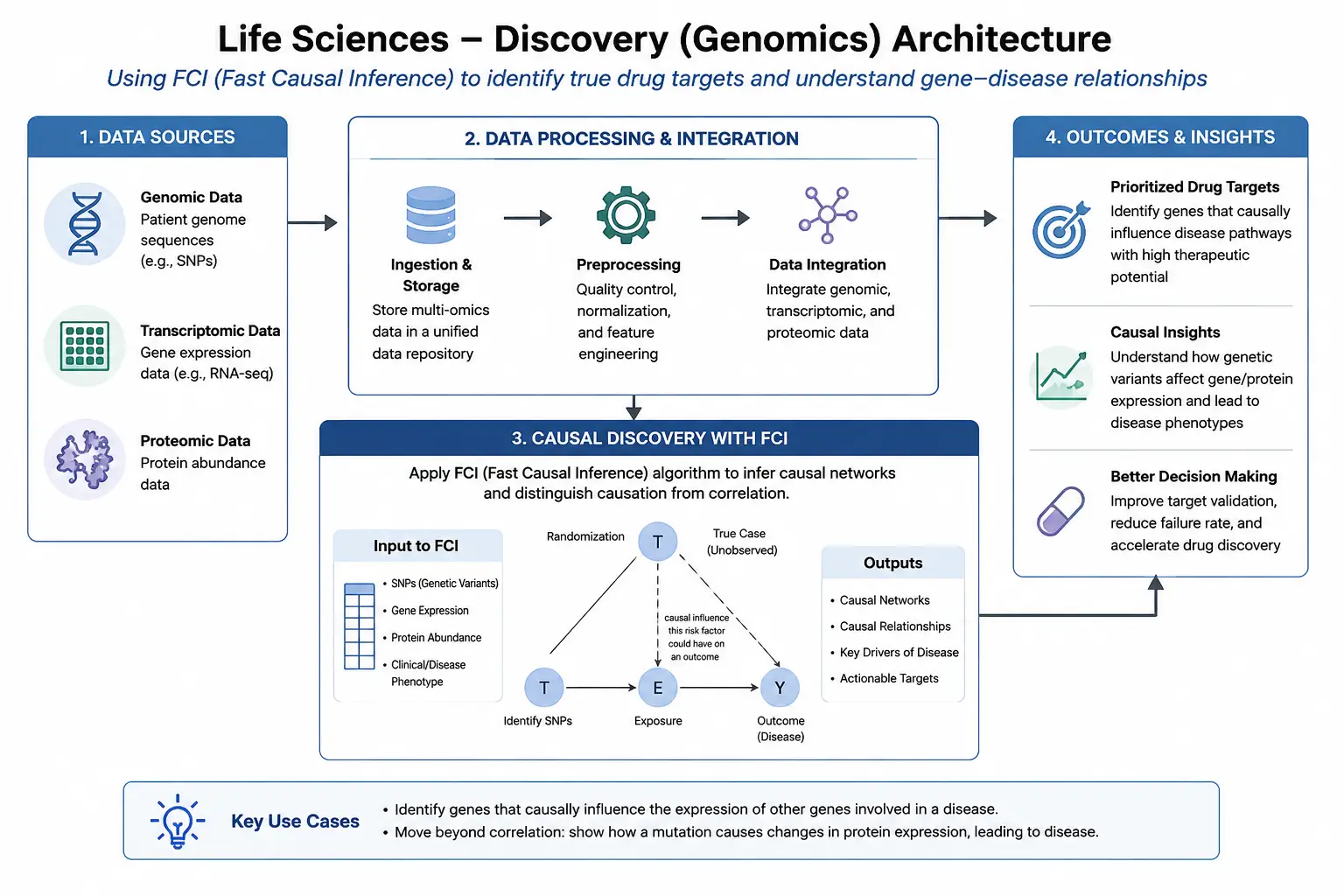
- Data Integration: Aggregated complex patient genome sequences alongside transcriptomic and proteomic data.
- Network Inference: Executed structural causal modeling to build robust network maps of gene and protein interactions.
- Pathway Tracking: Traced how gene mutations alter specific protein expressions to cause distinct disease phenotypes.
- Target Prioritization: Ranked and isolated genes that directly influence disease-involved expressions to uncover true therapeutic targets.
Key Components
- Genomic, Transcriptomic, and Proteomic Data Inputs
- Fast Causal Inference (FCI) Algorithm Core
- Patient Genome Sequence & Gene Expression Analytics
- Mendelian Randomization & SNP Exposure Modeling Framework
- PCA (Principal Component Analysis) Log10 Correlation Engine
Architecture Diagram
Technologies Used
- Fast Causal Inference (FCI) Algorithm: Used as the core machine learning mechanism to mathematically infer causal networks and directed pathways from highly complex biological datasets.
- Genomic Data Analysis: Study patient genome sequences and genetic variations.
- Transcriptomic Analysis: Understand gene expression and regulatory mechanisms.
- Proteomic Analysis: Examine protein expression changes associated with diseases.
- Mendelian Randomization: Employed to utilize genetic variants (SNPs) as instrumental variables, establishing whether an exposure has a true causal influence on the final disease outcome.
- Principal Component Analysis (PCA): Implemented for high-dimensional data reduction and log10 correlation structuring across multi-omic sum parameters.
- Genetic Correlation Analysis: Identify relationships among genes and disease pathways.
- Causal Discovery Models: Reveal cause-and-effect mechanisms rather than correlations.
- SNP Identification: Determine the causal impact of genetic variants on outcomes.
Summary
By introducing a causal discovery approach powered by the Fast Causal Inference (FCI) algorithm, this project transformed how drug targets are identified. Instead of evaluating thousands of simple correlations, the solution map-out direct biological pathways: verifying how a gene mutation changes a protein’s expression, and how that protein drives a disease phenotype. This advanced system effectively eliminates ambiguity, allowing biopharmaceutical teams to confidently prioritize high-efficacy targets and lower down-the-line clinical development risks.
#Genomics #BioTech #CausalInference #DataScience #DrugDiscovery #Healthcare #MultiOmics