
AI-Driven Preclinical Research & Drug Efficacy Mapping
MoSeq and Causal Inference for Drug Mechanism Analysis
Client
The client is a forward-thinking biopharmaceutical company specializing in central nervous system (CNS) drug discovery. The client focuses on developing next-generation anxiolytic therapies and sought to eliminate traditional, manual scoring bottlenecks in preclinical mouse models to gain precise, deterministic insights into drug mechanisms.
Challenge
Evaluating drug efficacy in preclinical trials is severely hindered by significant individual subject variability, which frequently obscures a drug's true therapeutic value and masks underlying biological mechanisms. Traditional behavioral scoring methods are highly subjective and prone to missing subtle, critical changes in posture, movement, and social interaction. Furthermore, conventional statistical frameworks correlate drug action with outcomes but fail to definitively prove and quantify the exact causal pathways—such as whether a drug's anxiety-reducing effects are directly mediated by specific biomarkers like hippocampal receptor expression.
Key Results
- Automated Phenotyping Precision: Successfully captured nuanced, subtle behavioral modifications (movement and posture) across subjects using automated MoSeq analysis, eliminating human bias.
- Quantified Causal Drug Impact: Established a definitive causal baseline proving that drug administration directly reduced post-trial anxiety scores by 5.0 units compared to control groups ( β1=-5.0).
- Biomarker Regulation Mapping: Mathematically proved that the drug causes a distinct 2.0-unit increase (γ1=2.0) in hippocampal 5-HT1A receptor expression.
- Decoupled Mediation Pathways: Isolated and verified that higher 5-HT1A expression independently drives a 1.5-unit decrease (α1=-1.5) in anxiety scores, confirming the biological mechanism of action.
Solution
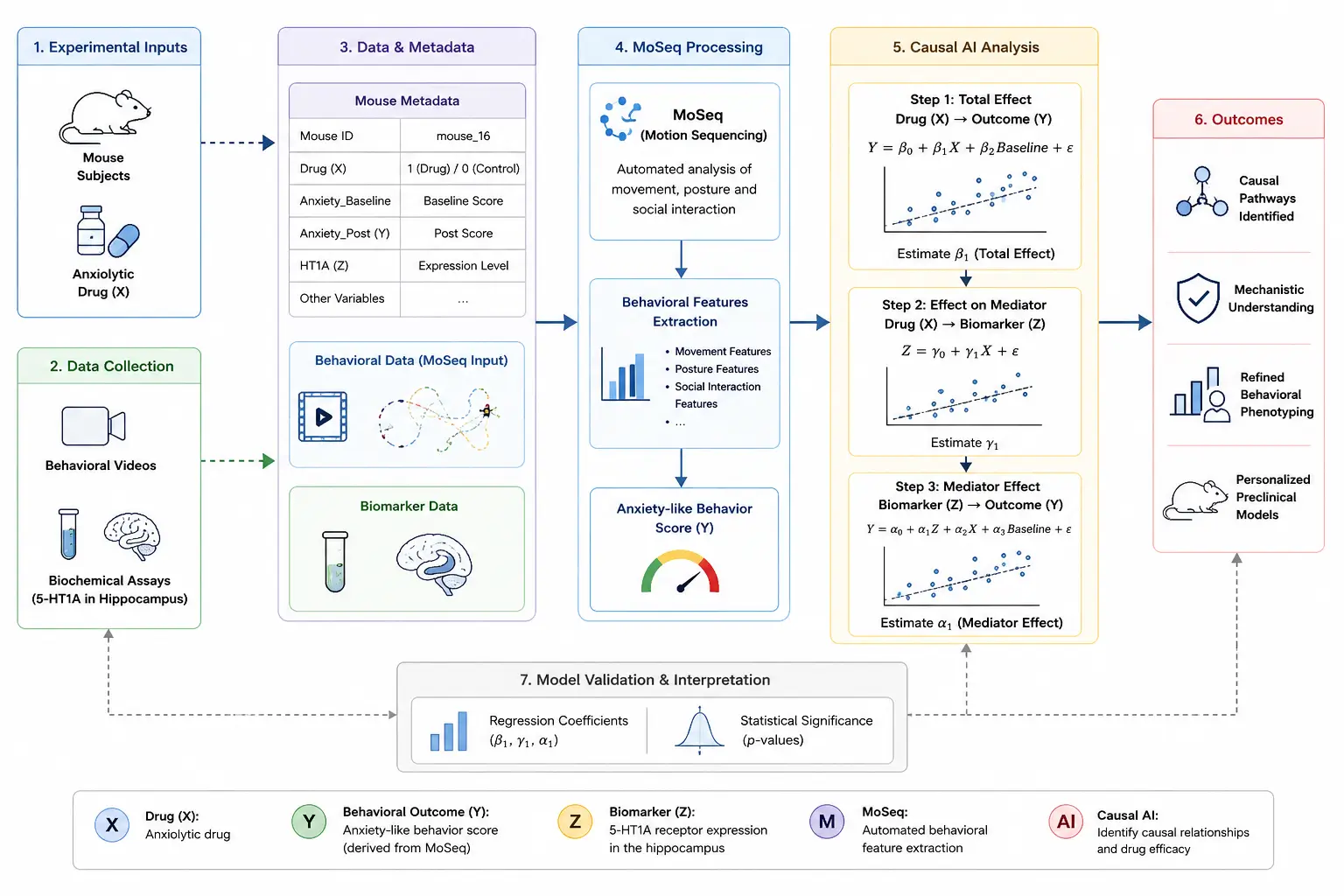
A comprehensive data science solution integrating automated 3D behavioral tracking (MoSeq) with multi-stage causal AI regression models to explicitly map and quantify the biological pathways from drug administration to biomarker expression and behavioral outcomes.
Step-by-Step Implementation
- Step 1: Quantify Total Causal Effect: Built a foundational regression model Anxiety_Post = β0 + β1 * Drug + β2 Anxiety_Baseline +ε to isolate the total direct impact of the drug ( β1 ) on behavioral outcomes.
- Step 2: Measure Drug-to-Biomarker Activation: Developed a secondary regression model ( 5 - HT1A = γ0 + γ1 * Drug +ε ) to calculate the specific causal impact ( γ1 ) of the drug on hippocampal receptor expression levels.
- Step 3: Map Independent Mediator Impact: Formulated a composite regression model ( Anxiety_Post = α0 + α1 * 5 - HT1A + α2 * Drug + α3 * Anxiety_Baseline +ε) to determine the independent causal strength ( α1 Target) of the biomarker on anxiety reduction.
- Step 4: Statistical Validation: Evaluated p-values and regression coefficients to mathematically confirm that the therapeutic pathways were statistically sound and not driven by chance.
Key Components
- MoSeq (Motion Sequencing) Behavioral Feature Extractor: Automated system capturing high-dimensional behavioral features, including posture and movement signatures.
- 3D Depth Imaging & Metadata Ingestion Engine: Handles raw subject inputs (e.g., mouse_16, weight, depth resolution array [424, 512], and sampling rates) from open-field testing environments.
- Biochemical Assay Data Interface: Integrates quantitative data representing hippocampal 5-HT1A receptor expression levels.
- Causal AI Regression Engine: Multi-variable mathematical modeling frameworks computing direct, indirect, and mediated causal coefficients (α1, β1, γ1).
Architecture Diagram
Technologies Used
- MoSeq (Motion Sequencing): Used for advanced, automated behavioral phenotyping; it extracts high-resolution, objective behavioral features from video feeds that human observers miss.
- Causal AI Frameworks: Used to build multi-stage linear regression models that calculate explicit mathematical coefficients (β,γ,α), transforming traditional correlation data into verifiable causal pathways.
- 3D Depth Sensing Technology: Utilized to capture real-time spatial data (via 16-bit depth arrays at specific sampling rates) of freely behaving subjects in an open-field setting.
- Biochemical Assays (5-HT1A Receptor Expression Tracking): Provides the biological ground truth data from the hippocampus to act as the primary mediator variable (Z) within the causal system.
Summary
By pairing automated behavioral tracking (MoSeq) with causal AI mediation modeling, Arocom IT Solutions successfully decoded the intricate biological mechanisms of a novel anxiolytic drug. Moving far beyond basic correlations, the solution provided explicit mathematical proof of how the drug alters hippocampal 5-HT1A expression to drive measurable anxiety reduction in preclinical subjects. This dual approach mitigates the historical challenges of individual subject variability, offering a highly sensitive, data-driven framework that refines behavioral phenotyping and paves the way for highly accurate, personalized preclinical models.
#PreclinicalResearch #CausalAI #MoSeq #BehavioralPhenotyping #DrugDiscovery #DataScience #BiotechAI #ArocomSolutions